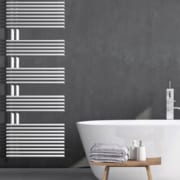
The challenge: heat in a small space

A small bathroom has special requirements. Where only a few square meters are available, every centimeter of wall space is precious. At the same time, the bathroom radiator should not only heat, but also dry towels, look good and match the furnishing style. This combination can be achieved if you keep the right dimensions, connection types and design aspects in mind when purchasing.

Width and height: the key dimensions in a small bathroom

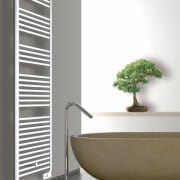
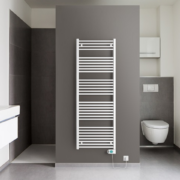
The general rule for small bathrooms is: it’s better to be narrow and high than wide and low. Narrow models from 40 to 50 centimetres wide can also be placed between the washbasin and the wall, behind the door or in niches without dominating the room. At the same time, their height provides enough heating surface to reliably heat the room to a comfortable temperature.

For the height, you should realistically measure the available wall space between the floor clearance and the ceiling or wall unit. Typical models in the design segment start at a height of around 1100 millimetres and go up to 1900 millimetres. A tall, narrow radiator also looks like it extends the room, which is a welcome side effect in narrow bathrooms.

Center connection or side connection: Which fits better?

The central connection has clear advantages in small bathrooms. The connections are located centrally below the radiator and do not protrude to the side. This enables symmetrical, tidy pipe routing and is particularly practical if the radiator is to be installed directly above existing floor connections. Many Caldo models, including the Evelino, are equipped with a central connection as standard or can be combined with one.

In the Colore Nero, the central connection is included as standard in all three design models (Asperto, Trentino, Evelino). This simplifies planning and installation considerably, especially for renovations where the connection position does not need to be changed.

Get more information now.

Open or closed form: Function meets design

Bathroom radiators are available in completely closed tubular form and in asymmetrically open versions. The open side makes it easy to hang and dry towels. Models such as the Trentino or the Asperto are open on one side and can be installed with the opening facing either left or right. This is particularly helpful in small bathrooms, as the mounting direction can be adapted to the room conditions.

Fully enclosed models such as the Evelino have a quieter appearance and fit better into minimalist bathrooms. Although they offer less hanging space, they heat more evenly and are easier to clean.

Targeted use of design effect in small spaces

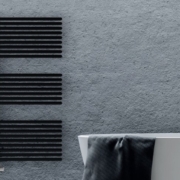
In a small bathroom, every design element stands out more than in large rooms. This also applies to the radiator. A model in white has a restrained effect and makes the room appear larger. Black surfaces such as the Colore Nero in RAL 9005 black matt, on the other hand, create a clear accent that works particularly well in modern and industrial-inspired bathrooms. If you are unsure about the color choice, classic white and a well-chosen model are always the right choice.

All technical data on widths, heights and heating capacities can be found in the data sheets in the download area.

Conclusion: Bathroom radiators for the small bathroom

Narrow, tall models with a central connection are recommended for small bathrooms, as they fit flexibly into the available space. The choice between an open and closed design depends on how important the towel function is, and the design should match the overall bathroom concept. Caldo offers a suitable model for each of these requirements.

If you are not sure which radiator suits your bathroom, we will be happy to help you. Contact us now.
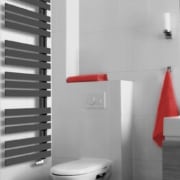
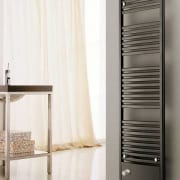
Bathroom renovation: why dimensions are so important

If you want to replace your old bathroom radiator, you quickly come up against a crucial question: what dimensions must the new radiator have so that the existing connections can still be used? If you don’t answer this question carefully, you risk expensive follow-up work, raised tiles and unnecessarily long installation times.

The good news: with the right preparation and the right radiator, replacements in existing buildings can often be carried out cleanly, quickly and without damaging the existing wall surfaces.

The two decisive dimensions when replacing radiators

Two dimensions are decisive for replacement in existing buildings:

  • Hub distance (NA): The horizontal distance from the center of the flow connection to the center of the return connection. For old panel radiators and radiators, this distance is standardized and is often 50 millimetres, but can vary depending on the model and year of manufacture. Measure this dimension precisely before ordering a new radiator.
  • Bottom edge distance to the middle of the return (UA): The vertical distance from the bottom edge of the radiator to the middle of the return connection. This dimension determines how high the new radiator must be mounted above the floor connection so that the existing pipe routing fits.

If you record both dimensions correctly, you can order a renovation radiator that is precisely tailored to the existing situation without having to lay pipes or open up tiles.

Get more information now.

The Evelino renovation radiator: Tailor-made for existing buildings

Caldo has developed the Evelino renovation radiator for precisely this situation. It is manufactured individually according to your specifications and is designed to have the same connection dimensions as standard panel radiators and old steel or cast iron radiators. The existing connections can continue to be used and no new pipes need to be laid.

All you need to order is the hub distance and the bottom edge distance to the middle of the return. With these two details, the radiator can be manufactured precisely. This not only saves installation costs, but also protects the existing tiling and wall covering.

Avoid typical mistakes during the inventory

The hub distance is often measured on the old radiator without taking into account that it may already appear slightly displaced due to rust, paint or old connectors. Therefore, measure directly at the pipe connections in the wall or on the floor and not on the radiator itself.

Also note whether the return is connected at the top or bottom. Different dimensional references apply to side valves than to the center connection. If in doubt, a specialist company should take stock to avoid incorrect orders.

Data sheets and tender documents as a planning aid

For professional planning, Caldo provides data sheets and tender documents for download. These contain all the necessary technical information, dimensional drawings and connection details for the Evelino renovation radiator.

Conclusion: Connection dimensions for bathroom radiators in renovation projects

Replacing an old bathroom radiator does not have to be a costly construction site. If you take careful note of the hub spacing and bottom edge distance and choose a custom-made renovation radiator, you save time, money and protect the existing building fabric. The Evelino renovation radiator from Caldo was developed precisely for this situation.

If you have any questions about taking measurements or product selection, please do not hesitate to contact us. Contact us now.

If the heating is not yet running, but the bathroom should already be warm

In the transitional period between summer and winter, the central heating is usually not running. Temperatures drop in the evening, the bathroom cools down and a fresh towel after a shower is anything but pleasant. It is precisely in this situation that an electric towel warmer shows its strength: it heats independently of the heating system, reacts quickly and can be controlled with pinpoint accuracy.

What an electric towel warmer can and cannot do

An electric towel warmer is not a complete replacement for central heating in winter. It is designed as a convenient addition. It warms towels, keeps the room at a pleasant temperature and dries damp textiles after showering. It is often the most economical and simplest solution for guest bathrooms, retrofitted bathrooms or bathrooms that are rarely used.

The electric models from Caldo work with a pre-assembled heating cartridge and are filled with thermal fluid ex works. They do not require a connection to the central heating system, but are plugged directly into the socket. Depending on the model and size, the heat output is between 500 and 1000 watts.

Alexandro and Trentino E: Flexible electric solutions from Caldo

The Alexandro electric towel warmer is versatile, whether in the bathroom, kitchen or utility room. Thanks to its clear design, it blends into different room concepts and can also be retrofitted with little effort thanks to its simple wall mounting.

If you need a slightly larger heating surface, the Trentino E is a model with an asymmetrically open side that is particularly convenient for holding towels while maintaining the room temperature. All Caldo electric models comply with the Ecodesign Directive ErP and Regulation (EU) 2015/1188.

Get more information now.

Control and energy consumption in everyday life

The integrated heating cartridges have six functions: Comfort mode with adjustable desired temperature, weekly program, booster mode for two hours of maximum output, window detection, night setback and frost protection. These functions help to limit power consumption to the level actually required.

If you only use the towel warmer in the mornings and evenings, a 500 watt model is usually very economical. In continuous operation at low outside temperatures, it is advisable to control the radiator via the weekly program so that it only heats when it is really needed.

Particularly valuable as a supplement to underfloor heating

Bathrooms with underfloor heating often lack a classic radiator. The underfloor heating warms the floor and the air, but not the towels. An electric towel warmer closes this gap without any structural interventions: no new pipework, no intervention in the heating system, just a wall hook and a socket.

Electric operation offers a clear advantage, especially for low-temperature heating systems that cannot be regulated up at short notice: it reacts immediately to demand, regardless of the central heating system temperature.

Conclusion: Electric towel warmer for transitional periods and guest bathrooms

An electric towel warmer from Caldo is not an emergency solution, but a well thought-out addition for bathrooms with special requirements. It is particularly suitable for the transitional period, for rarely used bathrooms and as a supplement to underfloor heating. Simple installation, clever control and attractive design make it a practical choice.

We will be happy to advise you on choosing the right model for your bathroom. Contact us now.

The surface is more than just a detail

Anyone planning a new bathroom radiator first thinks about dimensions, heat output and connections. But the surface is not a minor matter in the bathroom. In a room that often only has a few square meters, every design element is more important than elsewhere. The color and surface of the radiator influences the effect of the room, the maintenance required and the ability to combine with fittings, tiles and furniture.

White: The classic with good reasons

White is still the most popular finish for bathroom radiators, and for good reason. RAL 9016, the classic traffic white, blends into almost any bathroom design. It has a room-enlarging effect, can be combined with all tile styles and makes no mistakes. The Evelino bathroom radiator is available in this classic white, among other colors, and combines proven design with a high degree of planning flexibility.

White is also easy to clean: water stains are visible but easy to remove. White is the most reliable choice for family bathrooms with frequent use and changing users.

Matt black: trend color with a clear effect

Black bathroom radiators in matt RAL 9005 have established themselves as an independent design statement in recent years. They have a homely rather than technical appearance and set clear accents, especially when combined with light-colored tiles or natural surfaces such as stone and wood.

With the Colore Nero line, Caldo offers three design models in RAL 9005 black matt: Asperto, Trentino and Evelino. All three are equipped with a central connection and can be optionally supplemented with a heating cartridge for electric operation. The matt surface is easy to clean and shows fewer fingerprints than glossy black finishes.

Black suits modern, purist bathrooms, industrial styles with dark fittings and natural stone bathrooms with contrasting colors. If you opt for a completely metal finish for fittings, black radiators are the perfect finishing touch.

Get more information now.

Chrome: Timeless elegance with clear application limits

Chrome has a long tradition in the bathroom sector and remains a sign of quality. In addition to white, the Evelino is also available in a chrome version. Chrome goes particularly well in classically and timelessly designed bathrooms with high-quality sanitary ceramics and shiny fittings in the same finish.

However, chrome requires more care than white or matt black. Limescale stains and water marks are clearly visible on the shiny surface and need to be removed regularly. In hard water regions or with frequent use, this can mean maintenance work, which you should take into account when making your choice.

Which surface suits which bathroom style

As a guide: white is universal and safe, matt black is suitable for modern and high-contrast concepts, chrome goes well with classic and glamorous fittings. The decisive factor is always the combination with the other surfaces in the bathroom: fittings, tiles, furniture handles and mirror frames should be coordinated in the choice of finishes.

All available surfaces, dimensions and performance data can be found in the data sheets and product documents in the download area.

Conclusion: choose the right surface for your bathroom radiator

The choice between a black radiator, chrome or white is not just a matter of taste, but a decision that shapes the overall bathroom style. With the right information, you can make a choice that will satisfy you in the long term. Caldo offers a suitable model with a high-quality finish for each of these styles.

If you have any questions about color selection or the right model, please contact us. Contact us now.

Why replacement is often easier than expected

Many homeowners shy away from replacing an old bathroom radiator because they fear time-consuming installation work, open tiles and high tradesmen’s costs. In practice, however, a clean replacement is possible in many cases without major conversion work if the new radiator is matched to the existing connection situation and the inventory has been carried out carefully.

The inventory as a basis for the exchange

Before a new radiator is ordered, two measurements must be taken precisely: the hub distance (horizontal distance between the flow and return connections) and the distance from the bottom edge of the radiator to the middle of the return. These two specifications determine whether the new radiator will fit the existing connections without having to lay pipes.

You should also check whether the connection is at the side or in the middle, whether the flow and return are at the top or bottom and the condition of the shut-off valves. Old or calcified valves should be replaced immediately, as they can lead to more expensive repairs in the event of a later defect.

Renovation radiators: Tailor-made for existing buildings

The Evelino renovation radiator from Caldo has been specially developed for this application. It is manufactured individually according to the specified dimensions and has the same connection dimensions as standard panel radiators and old steel and cast iron radiators. The existing pipes and drill holes can still be used and tiles do not need to be opened.

Only the hub distance and bottom edge distance to the middle of the return are required for the order. The radiator is then manufactured and supplied to fit. Technical documents and tender texts are available in the download area.

Get more information now.

Visual enhancement as a welcome side effect

Replacing a radiator is always an opportunity to upgrade the look of the bathroom. A new designer bathroom radiator with a modern surface, clear lines and a contemporary profile noticeably changes the room’s appearance, even if everything else remains the same. If you opt for one of Caldo’s designer bathroom radiators, you not only get functional heating performance, but also a product that can be deliberately used as a design element in the bathroom.

A change from old white to a modern model in matt black is particularly effective. The Colore Nero line with Asperto, Trentino and Evelino in RAL 9005 black matt is ideal for bathrooms that need a modern look with minimal effort.

Economic benefits of a targeted exchange

An old radiator from the 1970s or 1980s often works with higher flow temperatures than would be necessary today. A new, optimally dimensioned radiator can be operated at lower system temperatures with the same or improved heating output. This pays off in the energy balance in the long term, especially if the heating system is to be converted to a more efficient mode of operation anyway.

Conclusion: Replacing bathroom radiators is worthwhile

Replacing a bathroom radiator without major alterations is feasible with the right preparation and the right model. Careful measurements, choosing a compatible renovation radiator and checking the valves at the same time are crucial. The result is a modern bathroom with better heating performance and a new look.

If you have any questions about replacing or selecting the right radiator, please contact us. Contact us now.

Heat pumps in old buildings: between expectation and reality

The heat pump is considered a central element of the heating transition. In new buildings designed for low system temperatures, they work efficiently and economically. In older buildings with existing radiators, the picture is more nuanced. Anyone thinking about retrofitting should know what works under what conditions and where the realistic limits lie.

Why the flow temperature is so crucial

The efficiency of a heat pump depends directly on the temperature difference between the heat source (ground, air or groundwater) and the heating system. The lower the required flow temperature, the more efficiently the heat pump works. As a rule of thumb, the efficiency decreases noticeably with every five degree increase in the flow temperature.

Classic radiators in old buildings are usually designed for flow temperatures of 70 to 90 degrees. Heat pumps work optimally at 35 to 45 degrees. This gap must be closed, either through larger heating surfaces, better insulation of the building or a combination of both.

When existing radiators are sufficient

In many existing buildings, the radiators were originally deliberately oversized. This means that they can still provide sufficient output at lower flow temperatures if the room is well insulated. Hydraulic balancing is essential here, as it ensures that all radiators have an even flow and that the system temperature can be lowered as much as possible.

Whether your existing radiators are suitable for heat pump operation can be determined with a heat load calculation in accordance with DIN EN 12831. This calculation shows how much heat a room requires at the coldest expected outside temperature and whether the existing heating surface can provide this with a low flow rate.

Get more information now.

Where it makes sense to replace radiators

In rooms where the existing heating surface is not sufficient, a targeted replacement is recommended. Caldo offers models such as the Adriano, the Mirro or the Liscio for living rooms, which, thanks to their design and heating surface, perform well even with a moderate flow rate. The technical data can be found in the data sheets in the download area.

The bathroom as a special case in the heat pump portfolio

The bathroom has special requirements in heat pump operation. Bathrooms are heated to 24 degrees and above, the radiator also has to dry towels and provide short-term comfort heat. Low-temperature systems, which heat slowly and evenly, are often not designed for these requirements alone.

A sensible solution is the combination of a hot water-operated bathroom radiator and an electric auxiliary device. The Evelino EB from Caldo is expressly designed as an additional heat source for low-temperature heating systems that cannot be heated up at short notice. It supplies heat as required without the need to adjust the central heating system.

Reasonable expectations for the portfolio

A heat pump in an old building works well in many cases, but rarely without accompanying measures. Anyone planning realistically will not promise miracles or make any blanket promises. The building envelope, existing heating surface, hydraulic balancing and the particular situation in the bathroom must be considered together.

Conclusion: radiators and heat pumps in existing buildings

It is possible to use a heat pump in existing buildings, but it requires an honest analysis of the existing situation. Existing radiators can continue to be used in many rooms if the hydraulic balancing is correct. In the bathroom, an additional electrical solution is recommended to cover comfort requirements independently of the system flow. Caldo offers suitable products for both scenarios.

If you would like to know which solution is right for your portfolio, please contact us. Contact us now.

Two systems, one decision

Anyone planning or renovating a bathroom will sooner or later be faced with the question: electric bathroom radiators or hot water radiators? Both systems are justified, and neither is fundamentally better than the other. Which is best depends on the installation situation, the existing heating system, the frequency of use of the bathroom and the desired level of comfort.

The hot water radiator: the proven standard solution

A bathroom radiator that is connected to the central heating system works together with the rest of the house in heating mode. It heats the bathroom when the heating is running and cools it down when it is switched off. This is efficient in winter, when the bathroom needs to be brought up to temperature regularly anyway. With well-insulated buildings and modern heating systems, this solution is usually the most economical.

Caldo offers a wide range of hot water bathroom radiators, from classic models such as the Evelino to designer models such as the Trentino and Asperto. All models are available in different sizes, finishes and connection options.

The electric bathroom radiator: flexible and independent

Electric bathroom radiators do not require a connection to the central heating system. They are connected to a socket and heat independently of the rest of the heating system. This makes them the first choice in bathrooms where there is no heating connection, in retrofitted bathrooms, in guest bathrooms or in rooms that only rarely need to be heated.

The Alexandro EB and Trentino EB from Caldo are fully electrically operated, pre-filled with thermal fluid and equipped with a digital heating cartridge. They comply with the Ecodesign Directive ErP and Regulation (EU) 2015/1188 and have six operating modes: comfort, chrono program, booster, window detection, frost protection and night setback.

Get more information now.

Combination as the best solution: hot water and electricity together

In many bathrooms, the best solution is to combine both systems. A radiator powered by hot water provides the basic heating, while an electric auxiliary radiator supplies heat quickly when required without having to start up the entire heating system. This combination is particularly useful for low-temperature heating systems and heat pumps, as the central heating system cannot be brought up to high temperatures at short notice.

The Evelino EB is specifically designed for this use as a supplement to low-temperature heating systems. It has the same external dimensions as the hot water-operated Evelino and can use existing fixing points, which simplifies installation.

Frequency of use as a decision criterion

For bathrooms that are used daily and by several people, the hot water connection is more worthwhile in the long term. For guest bathrooms that are only used occasionally, electric operation is more economical because no heating energy needs to be permanently provided for rooms that are rarely used. Operation can be precisely controlled with the weekly program of the electric models.

Conclusion: Electric bathroom radiator or hot water – which solution is better?

The answer depends on your specific situation. Hot water operation is the economical standard solution for bathrooms used on a daily basis with an existing heating connection. Electric operation offers maximum installation flexibility and is particularly suitable for guest bathrooms, rooms without a heating connection and as a supplement to underfloor heating or low-temperature systems. A combination of both is the smartest choice in many existing situations.

We will be happy to help you decide which system is best suited to your situation. Contact us now.

Why the topic of low temperatures in existing buildings raises so many questions

Anyone who heats an old building will be familiar with the situation: the radiators are old, the flow temperatures are high, and now it’s time to switch to a more efficient system. More and more often, the question arises as to whether the existing radiators are even suitable for lower system temperatures. The answer is not a general one, but depends on several factors that you should know before you plan or invest.

What low temperature means in practice

A low temperature is a heating mode in which the flow temperature is permanently below 55 degrees Celsius, usually between 35 and 45 degrees. Modern heat pumps are designed to operate as close as possible to these temperatures because their efficiency increases as the flow temperature falls. Conventional gas heating systems in old buildings, on the other hand, often work with flow temperatures of between 70 and 90 degrees.

This means that a radiator designed for 75/65/20 degrees delivers significantly less heating output at a flow temperature of 45 degrees. How much less depends on its size, design and the insulation standard of the room.

Which factors are decisive in the portfolio

Three factors determine whether low-temperature operation works in an old building: the building envelope, the available heating surface and the desired room temperatures.

A poorly insulated building with high transmission heat loss requires significantly more energy per hour in the heating load calculation than a renovated house. If you rely on low flow temperatures with poor insulation, there is a risk that the radiators will no longer be able to compensate for the heat losses in winter. In this case, only a combination of insulation measures and a larger heating surface will help.

Hydraulic balancing is not an option, but a must. It ensures that all radiators in the house have an even flow and that the flow temperature can be lowered as much as possible without individual rooms remaining cold.

Get more information now.

The bathroom as a special case

Different requirements apply in the bathroom than in the living area. While 20 to 21 degrees is considered comfortable in the living room, 24 degrees and more is often desired in the bathroom. At the same time, the bathroom in many existing buildings is small and the existing radiator is rarely large enough to reliably reach this temperature with a low flow rate.

What’s more, a bathroom radiator not only has to heat the room, but also dry towels and provide thermal comfort after showering. This short-term high heat requirement can often not be met with purely low-temperature operation via the central heating system.

When additional heat in the bathroom makes sense

This is precisely where the concept of electric auxiliary heating comes in. An electric bathroom radiator such as the Evelino EB from Caldo works independently of the central heating system and provides heat quickly when required without the entire heating system having to be started up. It is particularly suitable as a supplementary heat source for low-temperature heating systems that cannot be raised to higher temperatures at short notice.

This is not a contradiction to energy-efficient operation, but a practical solution for a room with special requirements. The Evelino EB complies with the Ecodesign Directive ErP and Regulation (EU) 2015/1188, is equipped with a digital heating cartridge and has a booster function, weekly program, frost protection and window detection.

Realistically evaluating domestic radiators in existing buildings

In the living room, an existing radiator can often provide sufficient heat even at a slightly lower flow temperature if the room is well insulated and the radiator is large enough. In many old buildings, the radiators were oversized anyway, which is an advantage today.

If you want to make a targeted exchange, Caldo offers domestic radiators such as the Liscio or the Adriano, which work efficiently even at moderate flow temperatures thanks to their flat design and large heating surface. Technical data and performance specifications can be found in the data sheets in the download area.

Conclusion: Low-temperature radiators in old buildings need an honest assessment

Whether low-temperature operation works in old buildings cannot be answered with a blanket yes or no. The decisive factors are the insulation standard, heating surface size and system balancing. In this context, the bathroom is often the most critical room because it combines the highest comfort requirements with the smallest available area. A well-chosen additional electrical solution closes this gap reliably and economically.

If you would like to know which radiator suits your situation, please contact us. Contact us now.